
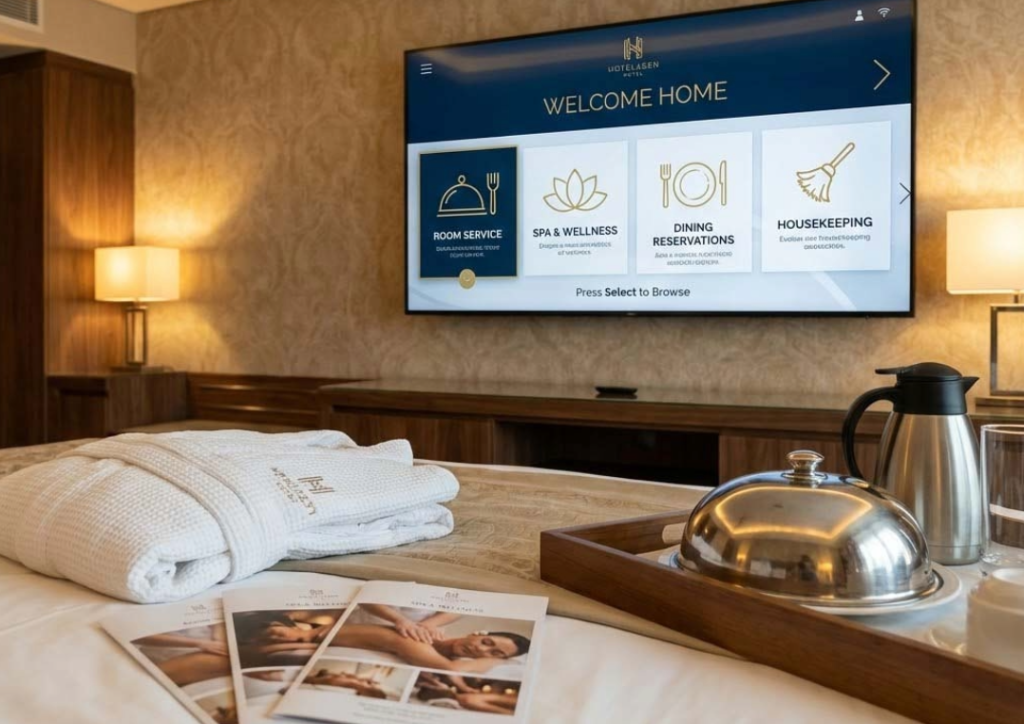
I travel for business a lot, and I’ve had this experience more times than I’d like to admit: I walk into an expensive, grand hotel room, everything looks premium… then I turn on the TV and the illusion breaks.
The menu feels basic. The interface is clunky. There’s no casting. Sometimes it’s just a generic welcome video that tells me nothing useful. And I catch myself thinking (quietly, because I’m polite): not really worth the money. Yes, I’m “turned off” — pun intended.
What’s interesting is that guests rarely report this as a formal complaint. Most won’t call the front desk to say, “Your TV UI isn’t premium.” They’ll just mutter to themselves that it’s “lousy,” “laggy,” or that the TV “kind of sucks,” especially when they can’t cast or the apps and menus feel years behind what they’re used to at home. They take mental points off the stay and start comparing you to the hotel down the street that feels more current for the same price. That silence is exactly why some owners think they can get away with it—until reviews soften, repeat intent drops, and the brand starts feeling “behind.” IT teams usually see the reckoning coming long before it shows up on a monthly report.
That’s why hotels need a modern hotel IPTV system. Not because cable is dead, and not because Android boxes can’t show channels. A modern hotel IPTV system is about delivering a managed in-room experience layer—premium UI, useful hotel information, consistent digital services, and an operating model that keeps it current across rooms and properties.
We often speak with hotel customers who mistakenly think that adding basic Android boxes behind the TV is “good enough” to modernize the in-room experience.
It looks like a quick win: channels still work, a few apps are available, and the capex feels lower than a full replacement.
The problem shows up after go-live. A basic Android box setup usually doesn’t give the hotel a proper IPTV experience layer—a welcome screen, a usable hotel information menu, consistent digital services, and a clean way to keep content current across rooms. And once different rooms start behaving differently (different app states, different settings, different “quirks”), the support load quietly climbs.
That’s when the replacement discussion becomes clearer. It’s not really IP vs coax. It’s whether the TV stays a basic playback screen, or becomes a managed guest touchpoint that reflects the hotel’s brand and service level.
A modern hotel IPTV system is designed to provide:
a consistent welcome and navigation experience
a proper hotel information and services menu
centralized publishing of content and updates
a cleaner operating model across rooms and properties
The in-room TV is one of the few screens the hotel controls end-to-end, and it’s often where guests settle in and decide what to do next—order something, head to the bar, book the spa, or just switch off after a long day.
A good hotel IPTV system helps at exactly that moment:
the room feels more current and more worth the price, which supports repeat stays
guests notice what the property offers more easily (dining, spa, facilities, events)
information is clear and up to date, so the stay feels organized rather than messy
Guests don’t usually say “the TV made me spend more,” but it shapes whether services feel discoverable or hidden, and whether the stay feels aligned with the price.
“To be, or not to be…” — yes, that is the question. In hotel TV terms: do we keep living with old Android boxes and outdated TVs for another year, or do we finally move to a proper hotel IPTV system?
The limitation of most ROI calculations is that they often ignore the downside of leaving an old TV setup in place. We assume guests will tolerate a dated menu, grainy picture quality, outdated hotel information, or one room behaving differently from another. In reality, guests may not say it out loud, but they notice—and they dock points for it. It shows up as a lower star rating, a “not worth the price” feeling, or them comparing you to the hotel down the street that feels more current for the same money.
When the TV experience is lacking, it’s not bad luck but “by design”—a signal the hotel hasn’t kept up, even if everything else seems great.
That’s why the ROI of a hotel IPTV system isn’t mainly about the feature list. It includes the support and operational costs you remove, the guest goodwill you protect, and the brand impression you stop quietly damaging.
Most TV issues aren’t dramatic incidents, but they still create friction at the worst times. Guests notice immediately, the front desk gets pulled in, and IT gets dragged into room-specific quirks. A stronger hotel IPTV system reduces the repeat problems—resets, inconsistent behavior, outdated menus—that keep coming back.
Dining hours, facility info, event schedules, and promotions change all the time. When the TV experience shows stale information, guests may not complain, but it makes the hotel look sloppy. A proper hotel IPTV system makes it easier to keep content consistent and current across rooms, without relying on manual room-by-room updates.
Guests don’t always say “your IPTV was great,” but they do judge whether the room feels modern and worth the price. When the TV experience looks neglected, it quietly drags down perceived quality. When it feels current and works smoothly, it reinforces that the hotel invests in the details—and that helps protect pricing confidence and repeat intent.
Hotels refresh TVs and networks over time. A managed IPTV approach usually ages better than a patchwork of boxes and local fixes, because you’re not rebuilding the operating model every time something changes.
And to put it in Shakespearean terms: “All that glisters is not gold.” A TV setup can look “good enough” until you account for the operational overhead and the guest perception cost.
If you’re planning a refresh, these are the questions that matter after go-live:
Can we deliver a proper welcome experience and a usable hotel information/services menu?
Can we keep content current without chasing updates room by room?
Can we standardize the experience across properties and maintain brand consistency?
Does the operating model reduce recurring support issues during busy periods?
Is there a clear lifecycle approach for updates, monitoring, and ongoing support?
ANTlabsEzTV is ANTlabs’ modern hotel IPTV system, designed to provide a managed in-room experience layer with centralized control for single properties and multi-property hotel groups. It can also work alongside in-room casting where relevant, so the hotel delivers a modern TV experience without creating extra operational complexity.
Enquiry: https://hospitality.antlabs.com/enquiry