
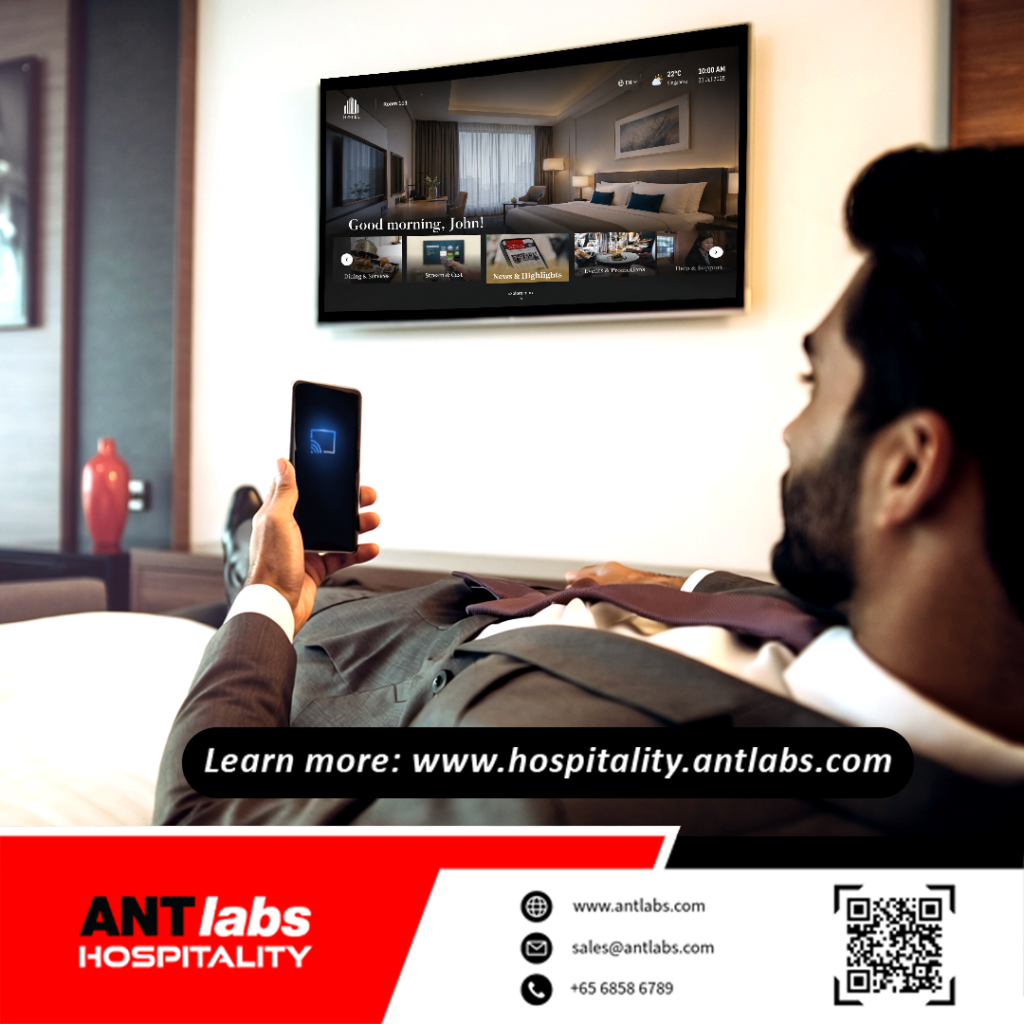
I was in a hotel room recently, tried to cast YouTube on the TV, and was surprised to see the previous guest’s account still listed among the signed-in users. I logged him out as courtesy, then reminded myself to log out manually before checkout too. Whoever you are, Mr. Adams, I did good by you, but that small moment stayed with me because a guest should not have to protect another guest’s privacy just to watch something on the room TV.
Guests now arrive with their own Netflix, YouTube, Spotify, Disney+, and other streaming habits, and they expect the room’s TV to let them continue that experience easily on the big screen. Streaming already accounts for a significant share of global internet traffic, and the in-room television has become part of how guests relax, unwind, and enjoy the room after a long day.
For many hotels, the fastest-looking answer is a consumer casting stick plugged into the back of each TV. It looks familiar, affordable, and easy to test in one room, but the cost appears when the same setup has to support daily room turnover, shared screens, full-house streaming demand, different guest devices, and hotel teams that cannot spend time checking every room device manually.
A room for TV may be used by one guest on Monday, another on Tuesday, and a family with several devices by the weekend. That same screen may carry YouTube one night, Netflix the next, and music or children’s content after that. The guest expects it to feel personal, while the hotel needs the setup to remain secure, visible, and manageable after every checkout.
Unmanaged casting often requires guests to sign in to personal streaming apps directly on the device or TV. When a guest checks out in a hurry, their Netflix, YouTube, Spotify, or other session may stay logged in, leaving personal accounts, viewing history, and linked profiles visible to the next occupant. Even when no severe damage occurs, the current guest sees a room for technology setup that feels careless.
The hotel team feels the problem in daily operations. A room may need a manual logout; another may need a reset, and another may behave differently after a device update from the manufacturer. These issues usually reach the front desk or duty manager first, and someone may have to check out the room or contact an external vendor when the problem cannot be resolved quickly.
A guest who signs into an app directly on the room TV may leave behind an active session, viewing history, or linked profile after checkout. Seeing another guest’s account on screen makes the room’s technology feel careless and reminds the current guest to worry about whether their own account will be exposed next.
ANTlabsEzCast allows guests to cast supported content through QR-based access instead of entering personal streaming credentials on hotel-owned equipment. PMS integration helps pair the guest device to the correct room, and session data is automatically cleared at checkout. The next guest receives a clean session, while the hotel reduces lingering logins, exposed viewing histories, and manual room checks.
The guest does not need to remember to log out of a shared TV, and the hotel does not need to depend on housekeeping, front desk, or engineering teams to catch up on every leftover account before the next occupant arrives. That makes TV casting for hotels safer, cleaner, and more practical for real hotel operations.
A hotel network carries much more than entertainment traffic. During busy periods, guests may be streaming, browsing, working, making calls, and connecting several devices at the same time. Consumer-style casting setups can add unnecessary network noise, especially when many rooms are occupied, and many guests are casting concurrently.
Some simple casting approaches may also rely on the TV’s own hotspot-like connection, which can take the TV out of the managed Wi-Fi environment and reduce visibility for the hotel network team. That makes it harder to see what is happening across rooms, harder to manage performance, and harder to treat casting as part of the broader guest connectivity experience.
When ANTlabsEzCast is deployed with SG5 HSIA gateways, casting traffic can benefit from, Advanced QoS and traffic shaping is designed to support smoother streaming performance during periods of heavy demand. ANTlabsEzCast is also designed to introduce less network noise than conventional casting approaches, helping hotels support a high number of casting devices more efficiently while keeping casting within a managed guest connectivity environment.
Standalone casting sticks quickly become difficult to manage across many rooms or properties. Each device can become its own small island, with its own reset behavior, update timing, pairing issues, and room-level workaround. A setup that looked affordable at the start can quietly become expensive in staff time, guest inconvenience, and inconsistent room experience.
ANTlabsEzCast can be managed through ASP Cloud, giving hotel teams a centralized environment for control, configuration, and reporting across rooms and properties. Instead of walking the property device by device, teams gain clearer visibility into the casting deployment and can manage the service as part of the broader hospitality platform.
For multi-property groups, this matters even more. A consistent casting platform helps standardize configuration, support, reporting, and guest experience across locations. Guests get a familiar and dependable in-room experience, while hotel teams avoid managing a scattered collection of devices that behave differently from room to room.
A casting upgrade should not automatically force hotels into a full room for technology replacement. ANTlabsEzCast supports multiple Chromecast generations, Android TV OS, ANTlabsEzTV STB, and selected hospitality TVs, giving properties a flexible path to modernize in-room entertainment without replacing every screen or device unnecessarily.
Per-cast target licensing keeps the commercial model transparent and scalable for different property sizes and deployment plans. Hotels can improve the guest entertainment experience while making better use of existing infrastructure, TVs, and operating budget.
This is especially important for hotel groups managing different property types, renovation cycles, and room technology standards. A practical TV casting for hotels strategy should support both today’s installed base and tomorrow’s room upgrade plans.
Guests do not need to know how QR-based pairing, PMS integration, automatic session clearing, ASP Cloud management, SG5 HSIA gateways, Advanced QoS, or traffic shaping work. They only notice whether the TV connects easily, whether their account feels safe, and whether the room experience feels as smooth as expected.
Consumer casting devices may look convenient at the start, but hotels operate in a shared, high-turnover, high-demand environment that home devices were not designed to handle. ANTlabsEzCast turns casting into a managed hospitality service: simple for guests, clearer for hotel teams, and better aligned with the privacy, reliability, and scale that modern properties need.
Talk to our team about building your scalable hospitality platform today.
https://hospitality.antlabs.com/enquiry
#ANTlabs #ANTlabsEzCast #HospitalityTech #HotelIT #GuestExperience #TVCasting #HotelStreaming #GuestPrivacy