
Hotel WiFi can look like a small operational detail until it becomes the reason a guest cannot work, stream, cast, check in online, message family, or join an important call. A poor connection can turn an otherwise good stay into a frustrating one.
Many properties still treat WiFi as basic infrastructure until the problem becomes too visible to ignore. Guest complaints and repeated front desk escalations are often tolerated as part of daily operations rather than treated as signs of a network problem that needs attention. But when a VVIP guest complains, a corporate account is affected, or a negative review calls out the connection, the same issue suddenly becomes urgent.
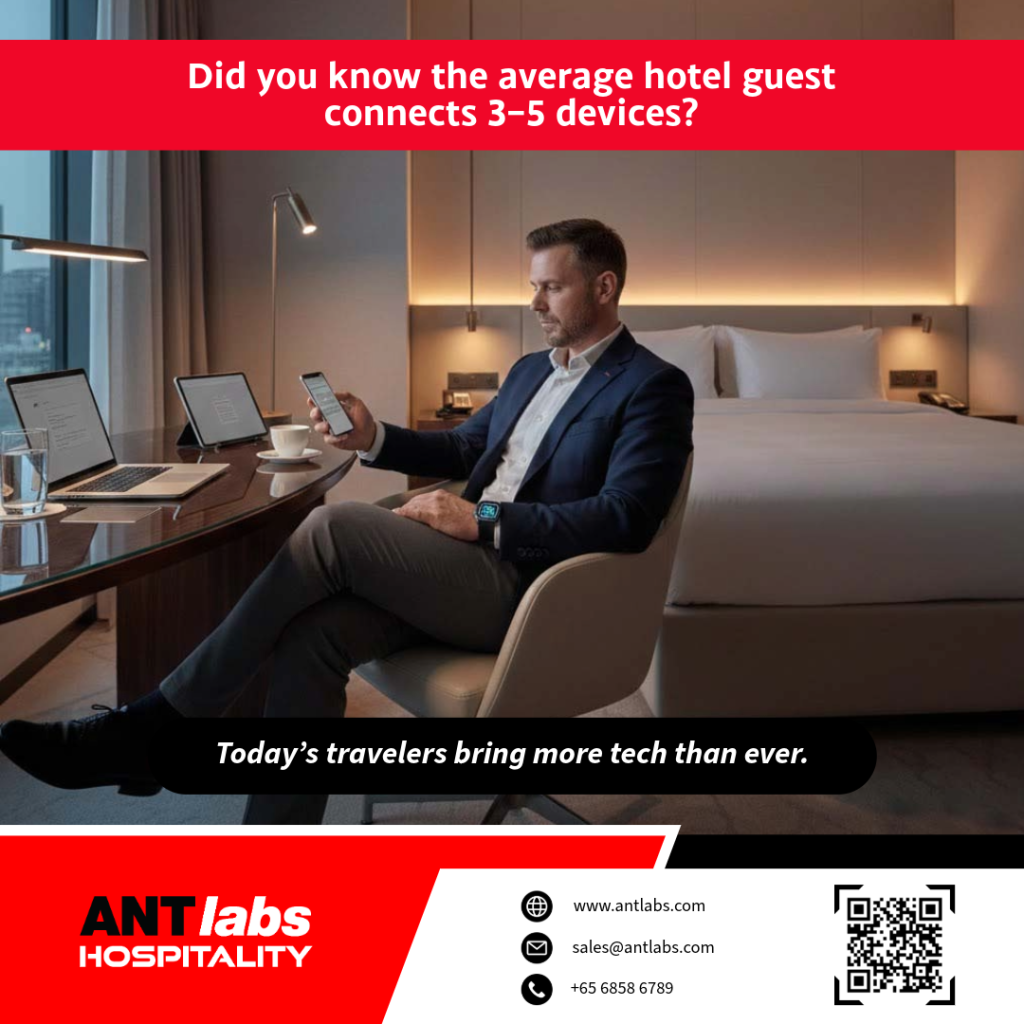
Hotel WiFi fails during peak occupancy when everyday guest activity scales faster than the network can manage it. Guest demand has become far more concentrated and device-heavy, with one occupied room now carrying mobile phones, laptops, tablets, gaming devices, streaming sticks, smartwatches, video calls, casting, streaming, messaging, and background app traffic. Multiply that across guest rooms, meeting spaces, restaurants, lounges, and event venues, and the network is supporting the digital layer of the entire stay.
IT managers see login issues, slow speeds, unstable calls, repeated front desk complaints, and a support queue that grows just when the property is busiest. Business and product managers see the same pressure through guest satisfaction, staff workload, and whether the stay experience still feels consistent with the brand promise.
A hotel network can appear stable on an average day because usage is spread out, guest behavior is easier to absorb, and support issues may appear manageable. Full occupancy changes the load pattern. Meeting spaces fill, guest activity concentrates around check-in, evening streaming, business calls, and event schedules, and the same infrastructure has to support many more simultaneous connections.
An IT manager may see gateway load rising, authentication errors increasing, traffic congestion spreading, or visibility gaps becoming harder to manage. A business product manager may see the same pressure through guest complaints, slower service recovery, and a stay experience that no longer feels consistent with the brand promise. Both are looking at the same network strain from different layers of the operation.
Bandwidth helps, although it does not resolve unmanaged demand, login friction, device diversity, or fragmented visibility across the property on its own. Modern hotel WiFi solutions need to manage how different guests, devices, applications, and locations behave when the property is operating at its busiest.
Many hotel WiFi complaints are described as speed problems because that is how guests experience them. A video call freezes, a page loads slowly, a streaming app buffers, or a device refuses to connect properly. From the guest’s point of view, the WiFi is simply not working well enough.
Behind the scenes, guest streaming, video conferencing, gaming, casting, background updates, and browsing may all be competing on the same shared network without enough traffic control. When every type of usage is treated the same, the network has little ability to protect the experiences that matter most at the right moment.
A business traveler on a call may need stable quality for 30 minutes. A family may have several devices streaming and browsing at once. A conference group may create a sudden wave of concurrent logins between sessions. Peak occupancy brings these patterns together, and older network models often struggle because they were not designed to make intelligent decisions under that level of mixed demand.
A network slowdown quickly becomes a front desk question, then an IT ticket, then a guest experience concern. When the pattern repeats across busy periods, the hotel is dealing with recurring operational inefficiency rather than isolated WiFi complaints.
Peak occupancy increases login demand, especially during check-in windows, event arrivals, and group stays. Captive portals that confuse guests, require repeated logins, or behave poorly on certain devices move the issue from the network layer into the service experience.
Modern guests connect through mobile phones, laptops, tablets, gaming devices, streaming sticks, smart TVs, and devices without a proper keyboard, camera, or browser-friendly interface. International guests may also come from markets where certain social login methods are unavailable, unfamiliar, or unsupported.
For IT teams, every failed login becomes a small operational distraction. For front desk teams, every WiFi question adds pressure during the busiest part of the guest journey. For guests, the inconvenience feels immediate because connectivity is expected to work from the moment they enter the room. Good authentication design reduces friction, especially when hotel WiFi solutions need to account for real device behavior, guest diversity, and the operational cost of every avoidable login issue.
Manual troubleshooting may still feel manageable at a single property, even when it is inefficient. The challenge grows across multiple buildings, venues, brands, or properties, where every isolated gateway, inconsistent configuration, and site-specific process adds time to each incident.
If every gateway is managed separately, every incident takes longer to understand. IT teams may need to check individual sites, wait for someone on location, compare inconsistent configurations, or repeat the same update across multiple properties. During peak occupancy, that delay matters because the guest experience is already being affected.
A hotel group may invest heavily in brand standards, room experience, service training, and digital guest journeys, while inconsistent connectivity still undermines the experience. Guests do not separate the network from the stay; they simply remember whether the hotel made it easy to work, stream, browse, cast, or stay connected.
When IT teams can monitor network health, manage access policies, receive alerts, and perform initial troubleshooting from one place, they can respond faster and reduce unnecessary site-by-site effort.
A stronger hotel WiFi strategy starts with treating the network as part of the hotel’s operating platform because so many guest-facing services now depend on it. Purpose-built hotel WiFi solutions bring together high-density gateway performance, intelligent bandwidth control, flexible authentication, centralized visibility, and remote management.
ANTlabs SG5 Gateways and ASP Cloud are designed around this hospitality reality. SG5 Gateways provide the on-property foundation for guest access, Advanced QoS, multiple authentication methods, PMS integration, and policy control. ASP Cloud extends that capability across the property or portfolio, giving IT teams a centralized way to monitor network health, manage deployments, support remote troubleshooting, and standardize configuration.
For the IT manager, this means fewer blind spots and less repetitive manual work. For the business product manager, the connectivity layer becomes easier to align with guest experience, service tiers, loyalty expectations, and multi-property consistency. The result is a more reliable way to manage the many moving parts behind modern guest connectivity.
Peak occupancy should be one of a hotel’s strongest business opportunities, with full rooms, busy event spaces, and active guest areas translating into revenue, service momentum, and stronger brand impressions. That opportunity becomes harder to protect when IT teams are pulled into preventable troubleshooting, front desk teams answer repeated WiFi questions, and guests form opinions based on whether they can connect when it matters.
Advanced QoS helps manage competing traffic more intelligently. Flexible authentication reduces login friction. Centralized cloud management improves visibility and response time. Standardized infrastructure supports consistency across individual properties and larger hotel portfolios.
The Invisible Link is the infrastructure layer guests rarely see, yet always depend on. When it works, guests simply continue with their stay. When it fails, the network becomes part of the story. Hotels that approach connectivity as part of the guest experience are better positioned to protect service quality, reduce support pressure, and turn busy periods into smoother operations.
Talk to our team about building your scalable hospitality platform today.
https://hospitality.antlabs.com/enquiry