
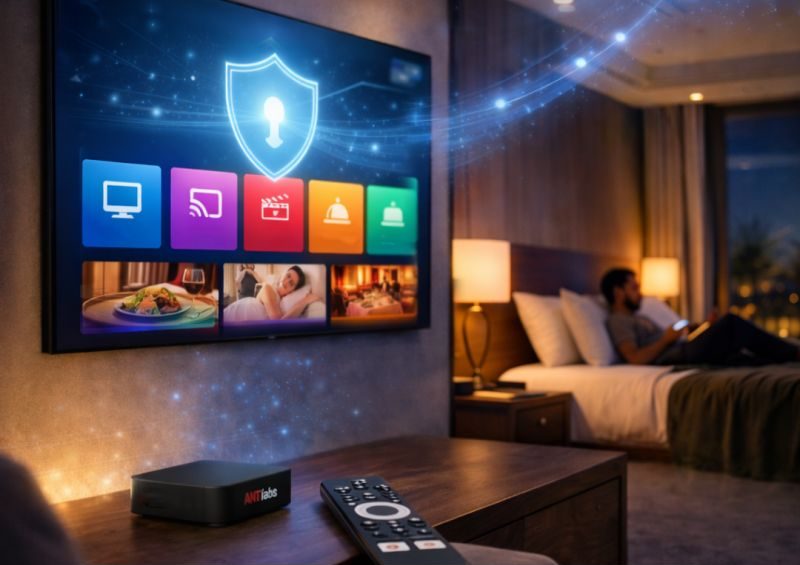
I’ve noticed something when I travel. I usually assume a hotel does not have TV casting, but I still check anyway because I want to continue binging YouTube, Spotify, or Netflix even when I’m on the road. When I see a Cast icon or a casting prompt on the TV, I’m not immediately impressed, but cautiously hopeful, because I’ve been burned before.
Some hotels use older mirroring technology that is not widely adopted. Some rely on proprietary methods that require an app and extra steps. Sometimes pairing succeeds but apps like Netflix or YouTube do not behave the way they do at home, latency feels high, and sessions become intermittent. That initial hopeful moment withers into disappointment, or the usual resignation that TV casting is not really supported again.
When it works smoothly, that’s when it becomes memorable. I grab the remote, jump on the bed, and gleefully call room service to send up snacks and drinks. The room suddenly feels more premium and welcoming, even if it has the same generic beige or dark interior that seems to be a staple in every other hotel.
This is not a niche expectation anymore. Nielsen’s The Gauge reported that streaming accounted for nearly half of all TV viewing in July 2025. Hospitality industry research also points to streaming access influencing hotel choice, with Hospitality Technology’s Customer Engagement Technology Study cited as finding that 70% of guests consider access to streaming services on in-room TVs when choosing a hotel.
That is why guests increasingly expect TV casting for hotels. It has become part of their normal routine.
Guests rarely praise TV casting directly when it works. Some will ask at the front desk if the TV supports it, but most simply test it quietly and move on. In a digitally connected society, TV casting can genuinely uplift the satisfaction of a stay, and the absence of it can do the opposite even if nobody makes a fuss.
Casting is not a feature that most guests will complain about directly. Instead, they mentally note that the hotel has not kept up with the times, especially when streaming at home is effortless and familiar. Reviews become more muted, value perception softens, and guests start comparing nearby hotels purely on cost, even if the service is top-notch.
If you’ve watched Harry Potter, you’ll remember Ron trying to cast spells with a broken wand. It’s funny on screen, but in a hotel, casting to the wrong-room TV spells trouble. This is where TV casting for hotels stops being entertainment and becomes a trust and reliability issue.
Room isolation: A guest should only see and connect to the TV in their own room. Casting to the wrong room is not a small glitch. Even when accidental, it is experienced as a privacy breach and it escalates quickly.
Session control and checkout clearing: Guests log into streaming services and cast personal content, so session clearing has to be automatic and reliable at checkout. When casting goes wrong, it can become an operational irritant, or at worst a PR fiasco. If staff need to reset devices manually, it will be missed sooner or later, and that is how avoidable incidents happen.
Reliability at peak occupancy: Many setups look fine in a demo room, but the real test is when occupancy is high and the network is busy. That is when intermittent discovery, pairing instability, and “it worked yesterday” behaviour show up and create repeat complaints and troubleshooting.
Operationally, casting problems are repetitive, and hotel teams recognize the pattern instantly. Guests cannot find the right TV, pairing fails, the wrong room appears in the list, or pairing succeeds but the guest still calls because Netflix or YouTube does not behave the way it does at home. Latency or intermittent connections make the experience feel unreliable, even when nothing is completely “down.”
What starts as a well-intended guest feature quickly turns into front desk calls, then repeat IT troubleshooting, and sometimes vendor ping-pong if ownership is unclear. From the IT manager’s perspective, the burning question is simple. Does the casting solution stay consistent when occupancy is high and the network is under load, or does it become a new category of support tickets that spikes exactly when the property is busiest.
Visibility matters here. If the first signal is a guest complaint at the front desk, the team is already reactive. Logs and dashboards help IT confirm what happened and where, without guessing room by room.
It is tempting to treat casting as a feature checklist item, but guests do not experience it that way. When casting works, guests settle in faster, the room feels more welcoming, and they are more likely to relax, spend time in-room, order something, and leave with a better impression. That is the Guest Experience to Revenue Impact link.
It is not that casting sells something directly. It is that TV casting for hotels influences whether the room feels worth the rate and whether the guest is inclined to come back, especially when competing hotels can deliver the same streaming comfort with fewer steps.
If you are evaluating TV casting for hotels, these checks usually predict whether the rollout will be quiet or painful. They determine whether the solution behaves predictably at scale rather than only in a demo room.
Look for room isolation by design so guests only see their own TV. Look for automatic reset at checkout so sessions and device state do not linger. Look for consistent app behaviour and acceptable latency so pairing translates into a smooth streaming experience. Finally, look for visibility with clear operational ownership so incidents can be diagnosed quickly without vendor handoffs or room-by-room guesswork.
This is exactly the problem space ANTlabs designed for. ANTlabsEzCast is built as secure in-room casting for hospitality with QR-code pairing, room-linked sessions, and automatic reset at checkout so no personal data is left behind. It is centrally managed through ANTlabs ASP Cloud, giving hotel IT visibility into device health and casting session status.
Hotels also benefit when casting is not deployed as an isolated island. ANTlabs supports deployments where casting is delivered alongside guest Wi-Fi HSIA and hotel IPTV as part of a unified hospitality stack, reducing vendor handoffs and simplifying operations when something needs troubleshooting.
If you are reviewing TV casting for hotels this year and want a hotel-grade approach, talk to our team:
https://hospitality.antlabs.com/enquiry
Guests do not describe their stay in terms of protocols or discovery behaviour. They describe it as easy or annoying, modern or dated. When TV casting for hotels works the way guests expect, it creates that small, gleeful moment that makes the room feel right. When it fails, the consequences land on front desk, IT, and the brand.
Make it fun for guests, not pain for IT.
Talk to us: https://hospitality.antlabs.com/enquiry
More on ANTlabsEzCast: https://hospitality.antlabs.com/products/in-room-casting/
#ANTlabs #ANTlabsHospitality #TVCastingForHotels #ANTlabsEzCast #HotelIT #HospitalityTechnology #GuestExperience #HotelOperations #HotelTech #InRoomCasting