
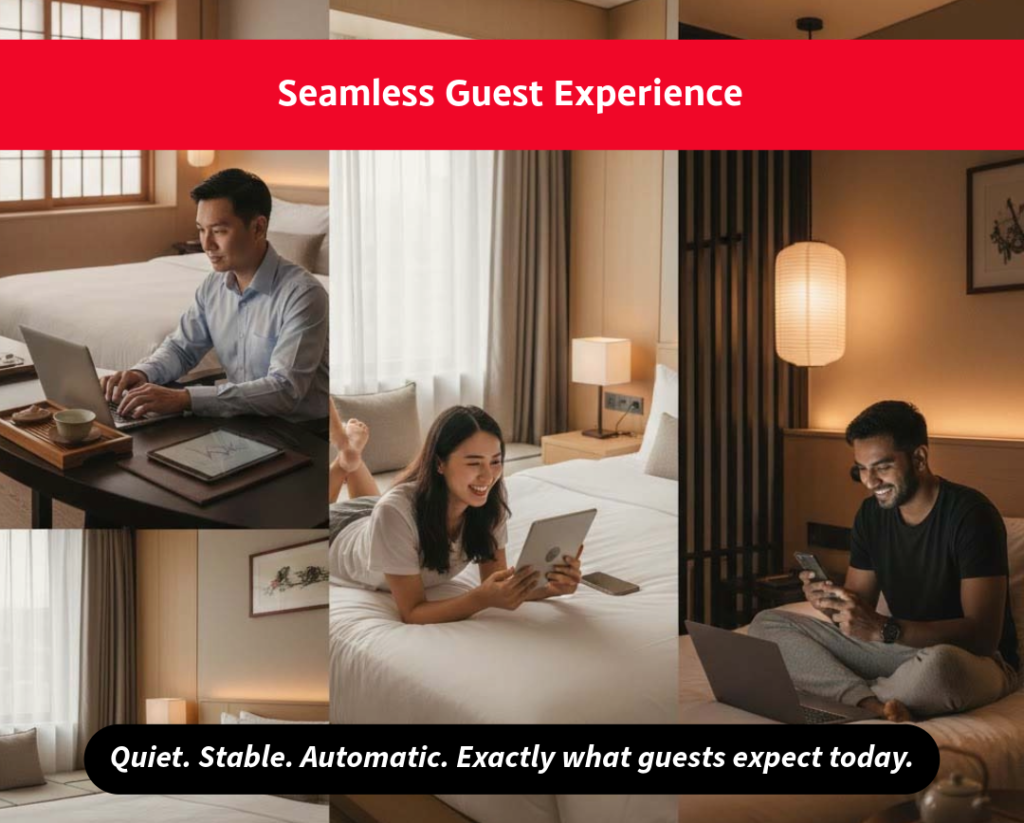
If you ask travelers what they value in a hotel, breakfast and Wi-Fi are usually near the top. Breakfast is easy to appreciate because it is visible and time-boxed. Wi-Fi is different. Guests use it for hours across a stay, for work calls, streaming, messaging, and planning.
AHLA’s 2024 consumer research reflects that shift. 63% of travelers rank high-speed Wi-Fi among their top three technology priorities, and 35% rank it as the top technology amenity when evaluating hotels. (AHLA, 2024)
So when Wi-Fi is frustrating, guests don’t treat it as a minor amenity issue. They experience it as the room quality not meeting the expected basic standard they paid for.
Guests rarely write a technical breakdown. They write one sentence: “Wi-Fi kept dropping”, “slow internet”, “couldn’t work”, “not worth the price”. Research that analyzes hotel reviews also treats Wi-Fi as a meaningful attribute that shows up in negative reviews and impacts ratings.
A practical rule of thumb many hotel teams recognize is this: poor Wi-Fi can cost you “up to 2 stars” in how the guest scores the stay in their head, even if they only write one line about it. The point is not the exact number. The point is the disproportionate weight that connectivity friction carries.
When hotel wifi solutions are not operationally sound, you rarely get one dramatic outage. You get predictable spikes in complaints during peak usage.
The complaints themselves are consistent:
Poorly designed hotel Wi-Fi solutions often treat connectivity as a basic utility rather than a managed guest experience. This leads to fragmented systems, inconsistent onboarding, and limited visibility, which forces teams into reactive troubleshooting instead of proactive management.
From an IT perspective, the fixes are straightforward but require the right architecture. This is where ANTlabs aligns with operational needs. The ANTlabs SG5 Gateway enforces policy and bandwidth control at the network edge, using Advanced QoS to maintain fair and stable performance during peak demand. Meanwhile, ANTlabs ASP Cloud provides centralized visibility and management across properties, enabling teams to standardize performance and resolve issues faster, especially when occupancy spikes.
These are not new or sophisticated problems. They are known issues that usually map back to three basics: bandwidth and fair use at peak, stable onboarding and authentication, and visibility to pinpoint issues quickly.
From the IT side, the fixes are not mysterious. They are the common, known issues: bandwidth and fair use at peak, stable onboarding with PMS integration, and enough visibility to diagnose quickly instead of guessing room by room. This is where ANTlabs comes in. Our SG5 gateways sit at the edge to enforce policy and bandwidth control, including Advanced QoS on the gateway to keep performance fair and stable during peak usage, while ASP Cloud provides centralized management and visibility across properties so teams can standardize and troubleshoot faster when occupancy spikes.
Wi-Fi does not need to “generate revenue” directly to affect revenue. It shows up in outcomes hotel teams care about: whether guests feel the room rate is justified, whether reviews turn sour, and whether guests choose you again next time.
In practice, the pattern is familiar. If Wi-Fi is frustrating, with dropouts, repeated logins, and inconsistent performance, guests stop describing the stay as “great value.” They start describing it as “not worth it,” and they start comparing you to the nearby hotel that feels smoother for the same price.
This is why hotel wifi solutions should be evaluated as guest-facing infrastructure, not a commodity line item.
If you are reviewing hotel wifi solutions this year, these questions usually surface the real issues faster than a speed test:
ANTlabs positions hotel wifi solutions around the operational realities hotels face at peak occupancy, across single properties and multi property groups.
If you are seeing recurring Wi-Fi complaints in reviews or predictable peak-time spikes in tickets, it is usually a sign that the hotel has outgrown “good enough.” The goal is not the highest speed test. The goal is a stay that feels effortless.