
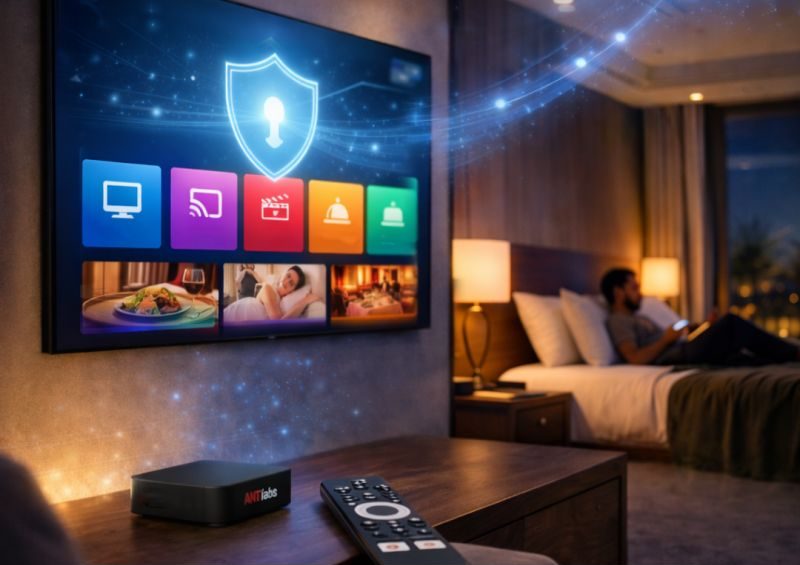
Casting has become one of the most sought-after in-room features. Guests notice it immediately, feel excited when it’s available, and expect it to work as easily as it does at home. When it doesn’t work—or when it feels unsafe—it frustrates them fast, and the front desk hears about it first.
This is why a hotel casting solution is more than just a “nice feature.” It’s guest-facing infrastructure that sits on your network and touches privacy expectations directly. Security has historically been easy to underweight in casting decisions—until wrong-room casting (casting to the wrong room) or a leftover session turns it into a guest-facing problem.
If you want the movie version: a casting demo is the trailer. The real story starts when the hotel is full and every room is trying to stream at once.
In a home, casting is simple: one household, a familiar network, and devices that don’t change hands every day. Hotels are the opposite: constant turnover, high device churn, and many rooms operating side by side.
Secure casting in hospitality comes down to a few non-negotiables:
Room isolation: a guest should only see and connect to the TV in their room.
Session control: a guest session must not linger after checkout.
Data protection: no leftover accounts, tokens, or “remembered” devices.
Predictable behavior under load: the real test is peak occupancy, not a quiet afternoon.
This isn’t just “good practice.” It’s how you avoid casting becoming a plot twist for the guest.
1) Wrong-room casting and cross-room discovery
Nothing breaks trust faster than wrong-room casting (casting to the wrong room)—when a guest sees the wrong TV on their phone, or their device shows up in someone else’s room. Sometimes it’s accidental. Sometimes it becomes a prank. Either way, it feels like a privacy breach—even if no one intended harm.
This is where the movie Taken is a good analogy. When casting jumps rooms, it doesn’t feel like a harmless glitch—it feels like someone “took” control of their screen. And if we borrow Liam Neeson’s vibe: “I will find you”… in a hotel, the front desk gets the call in five minutes, and IT/security gets pulled in later to figure out what actually happened—IF the system gives you enough visibility to find the cause. (Spoiler alert: not every solution does.)
2) Leftover sessions and account exposure
Guests stream personal content and log into services. If a session isn’t cleared properly, the hotel can end up with a serious “previous guest” incident that escalates quickly. This is the sort of thing that can turn a 5-star stay into a 3-star review in one paragraph.
A secure hotel casting solution should make session clearing the default outcome, not something staff has to remember to do.
3) Peak occupancy is the real security test
At 90% occupancy, casting systems face the hardest conditions: high device churn, high concurrency, and a busy guest network. If behavior becomes unpredictable under load, privacy confidence drops fast—even if the root cause is “just” design limits. A secure hotel casting solution should be stable at peak, not only on a good day.
A common refresh path is moving from old external Chromecast dongles to newer hospitality TVs with built-in casting. On paper, that can reduce device clutter and simplify deployments.
But the same core question remains: does the built-in solution deliver hotel-grade controls?
One practical example: some built-in approaches rely on the TV acting as its own Wi-Fi hotspot and pulling the guest device off the hotel network. In practice, this can create a frustrating experience because the device may swing between networks—especially if either the hotel Wi-Fi or the TV hotspot is less robust—leading to intermittent casting, dropped sessions, and “why did it disconnect again?” moments. It can also reduce IT visibility and control, because the guest device is now sitting behind the TV’s hotspot, which makes troubleshooting and policy enforcement harder.
A secure hotel casting solution has to be both reliable and secure, because the two reinforce each other. If the experience is unstable, teams fall back to workarounds, and workarounds create risk. If the setup isn’t secure, guests won’t trust it, even if it connects quickly.
A secure hotel casting solution should be evaluated on:
room-to-room isolation and how it is enforced
session clearing and privacy controls
behavior at peak occupancy (the real test)
operational visibility (how quickly issues are detected and resolved)
who owns ongoing compatibility and support as casting ecosystems evolve
This is where the Sherlock-and-Watson analogy helps. Reliability is Watson doing the steady work—keeping sessions stable and preventing the same complaint from repeating all night. Security is Sherlock, because in hospitality you can’t assume anything about the next device or the next guest, and you don’t want a surprise Moriarty on the guest network. When you have centralized visibility, you catch patterns earlier and avoid firefighting later.
If you’re procuring or replacing casting this year, prioritize the fundamentals that hold up after go-live:
Designed for hotels, not homes
Ask what it looks like at 90% occupancy, with high device churn.
Privacy by design
Room isolation and session clearing should be defaults, not optional add-ons.
Operational model that reduces tickets
A secure design should reduce resets and repeated troubleshooting, not just shift the burden.
Clear ownership and visibility
Casting often touches Wi-Fi behavior, discovery, and TVs. The escalation path should be clear, and issues should be visible centrally.
Because in hospitality, you don’t want a casting solution that needs constant “sequels.” You want something that stays solid after go-live.
ANTlabsEzCast is designed as a hotel casting solution delivered as part of ANTlabs’ hospitality platform, with an emphasis on operational stability and guest privacy rather than “demo-only” performance.
If you’re reviewing casting for your properties, talk to our team:
https://hospitality.antlabs.com/enquiry
#ANTlabs #ANTlabsHospitality #ANTlabsEzCast #HotelCasting #HotelCastingSolution #HospitalityTechnology #HotelIT #GuestExperience