
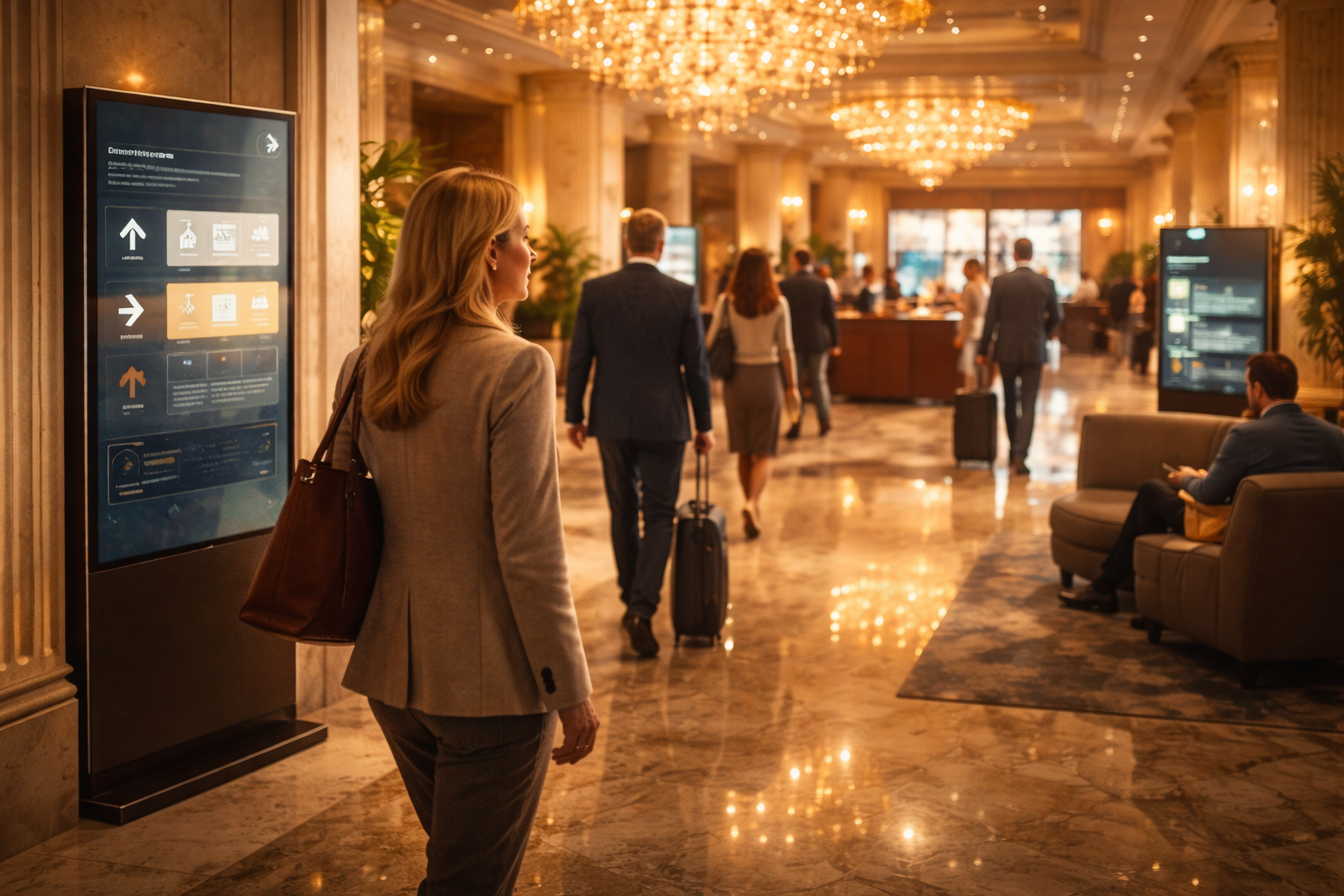
Digital signage is often treated like the sidekick in a superhero movie, always around, rarely credited, and only noticed when something goes wrong. But in a busy hotel, it has its own superpower: it can prevent confusion before it turns into queues, and it can surface the right information at the exact moment guests are deciding what to do next.
I noticed this in my own behaviour. When I’m new to a hotel venue for an event, I actively look for signage. I want to know where registration is, which ballroom I’m supposed to be in, and whether I’m walking in the right direction. In that moment, it’s essential.
But when I’m staying as a guest, I tend to ignore it, unless the message is relevant to what I’m deciding right then. Sometimes I only notice a spa or dining promotion on the last day in the lift and think, “I would have gone if I’d seen this earlier.” That’s not really a content problem. It’s a timing, placement, and management problem.
This is why digital signage for hospitality is often a missed opportunity. When it’s treated as “screens that play content,” it fades into the background. When it’s treated as experience infrastructure, kept current, governed, and reliable, it does two practical jobs at once: it improves guest flow (so the property feels calmer at peak times), and it helps guests notice the right offers at the right moment (so revenue opportunities don’t disappear quietly).
And there’s a technology analogy here too: unmanaged signage is a bit like an orphaned network session, it’s technically still “up,” but it isn’t doing what you think it’s doing, and it creates confusion precisely when the venue is busiest.
Guest experience doesn’t begin at the front desk. It begins the moment someone walks into the property and tries to figure out what to do next, where to go, who to speak to, and whether they’re in the right place. When that first five minutes feels smooth, everything else feels easier. When it doesn’t, the hotel can be operating fine and still feel messy.
Hotels have predictable pressure points: check-in and check-out windows, group arrivals, breakfast and dinner peaks, and the five minutes before a ballroom session starts.
When guests don’t know where to go, they stop, look around, ask someone, or head in the wrong direction and come back. Multiply that by hundreds of people during peak periods, and you don’t just get “a few questions” you get congestion.
Well-managed digital signage for hospitality helps by making direction and timing obvious in the places where guests hesitate: lift lobbies, corridors outside meeting rooms, the entrance to outlets, and the main arrival zone. It doesn’t need to be flashy. It needs to be clear. If guests can orient themselves quickly, movement improves, lines shorten, and the property feels calmer even at high occupancy.
Guests make small decisions constantly. Where is breakfast? Is the spa still open? What time is checkout? Which outlet is open late? What’s happening tonight?
If the answer isn’t easy to find, the default is the front desk, or the guest gives up and does nothing.
This is one of the underrated benefits of digital signage for hospitality: it can reduce repetitive “where/what/time” questions without feeling like the hotel is pushing guests toward an app or a QR code for everything. When information is visible and current, guests feel more confident navigating the property, and staff aren’t pulled away from service delivery just to repeat the same directions all day.
It’s also a brand cue. When a property consistently shows the right information at the right time, it feels organized. Not necessarily “luxury,” but well run—and that matters.
If your property hosts conferences or group events, guest flow becomes part of your reputation as a venue. The ballroom may be perfect, but if the corridors outside it are chaotic, that’s what people remember.
Agendas change, room assignments shift, sponsors rotate, and people arrive late and need to catch up. If signage can’t update quickly, confusion spreads into the lobby and hallways. That’s when you start seeing staff improvising with printed notices and people clustering around one screen that still shows yesterday’s schedule.
A centralized, cloud-managed approach to digital signage for hospitality makes a practical difference here. Updates should propagate in minutes across all relevant screens, so a change in one place doesn’t create confusion everywhere else. It’s a simple idea, but it’s the difference between a venue that feels professional and one that feels reactive.
Guests associate clarity with competence. It’s a simple human shortcut.
When screens are blank, outdated, or inconsistent, guests don’t think “the signage system is misconfigured.” They think, “this place feels a bit unmanaged.” And in hospitality, that perception spills over into everything else, even if the room itself is excellent.
On the other hand, when signage is current and consistent, it quietly reinforces that the operation is under control. It doesn’t need to “wow” anyone. It just needs to avoid creating doubt.
This is why digital signage for hospitality has a direct link to satisfaction. Not because guests rate signage itself, but because it affects how easy the property feels to navigate.
Digital signage delivers the most value when it isn’t treated as a standalone marketing system. In practice, it works best when it fits into the wider hospitality technology environment, guest network, IPTV, and guest engagement systems.
When signage sits in a separate silo, updates become slower, visibility drops, and responsibility becomes unclear (“Is this marketing’s problem or IT’s problem?”). Over time, that is how signage becomes neglected: still turned on, but not consistently maintained.
When digital signage for hospitality runs on an integrated platform, hotels can manage content more consistently, roll out updates faster, reduce on-site intervention, and keep messaging aligned across properties. Good guest flow isn’t accidental. It’s engineered.
Digital signage isn’t just visual communication. In a busy hotel, it becomes part of the experience infrastructure that reduces friction, guides movement, and helps the property feel calm even when it’s full.
Done well, digital signage for hospitality supports smoother arrivals, better event execution, fewer avoidable questions during peak periods, and a clearer brand experience across public spaces. Those benefits don’t always show up as “signage feedback,” but they do show up in operational efficiency, event execution quality, and how guests describe their stay.
If you’re reviewing your hospitality technology strategy, would a centralized and secure hotel IPTV and digital signage platform improve guest flow and reduce congestion during peak periods?
Learn how ANTlabs supports secure and centrally managed hotel IPTV and digital signage deployments:
https://hospitality.antlabs.com/products/hotel-iptv-solutions/
Or speak with our team about simplifying your entire guest digital infrastructure across properties:
https://hospitality.antlabs.com/enquiry
#ANTlabs #ANTlabsHospitality #DigitalSignage #DigitalSignageForHospitality #HospitalityTechnology #HotelIPTV #HotelIT #SmartHotel